23920 VALENCIA BLVD, SANTA CLARITA, CA, 91355 · Los Angeles County
2 adults, 1 older adult, 2 children, 1 dog
911Police, fire, medical emergency
1-800-222-1222Poison Control (24/7)
211Local help: shelter, food, services
988Suicide & crisis lifeline
Made November 21, 2026 from current data.
Your Top Risks
FEMA’s National Risk Index rates 18 natural hazards for every census tract by comparing likely losses, how vulnerable the community is and how well it can recover with the rest of the country. Your tract (06037920329):
Source: FEMA National Risk Index, December 2025. Hazards with no rating here aren’t listed. The ratings compare places; they don’t predict what will happen.
Your Location
Earthquake shaking (USGS)Very highStrongest expected ground shaking about 0.97 g (building code design category E).
Nearest mapped fault0.4 mi awayHolser fault, late quaternary activity (USGS).
FEMA flood zoneZone XMinimal flood hazard.
CAL FIRE fire hazard severity zoneNot in a mapped zoneWildfire can still reach unmapped areas, especially near open land.
California Geological SurveyLiquefaction zoneA mapped seismic hazard zone: extra damage from shaking is possible here.
Recent Federal Disaster Declarations for Los Angeles County
Year
Disaster
Type
2025
Canyon Fire
Fire
2025
Wildfires And Straight-line Winds
Fire
2025
Hurst Fire
Fire
2025
Eaton Fire
Fire
2025
Palisades Fire
Fire
2024
Franklin Fire
Fire
2024
Bridge Fire
Fire
2024
Severe Winter Storm
Severe Storm
2024
Severe Storms And Flooding
Severe Storm
2024
Severe Winter Storms, Tornadoes, Flooding, Landslides, And Mudslides
One page for each hazard that matters most here. The box at the top of each is what to do in the first ten minutes.
Floods and Flash Floods
Very High risk here
Floods happen when rivers, creeks, or storm drains overflow. Flash floods rise in minutes, often from heavy rain upstream, and moving water is stronger than it looks.
The First 10 Minutes
If told to evacuate, leave now.
Move to higher ground right away. Do not wait to see the water.
Turn Around, Don't Drown. Never walk, swim, or drive through flood water.
Stay off bridges over fast-moving water.
If water is rising inside your home, go to the highest floor. Go on the roof only if you must, and call 911.
Do not climb into a closed attic, where you could become trapped.
If your car is caught in rising water, get out and go to higher ground if you can do so safely. If water is rising inside the car, get on the roof and call 911.
Leave Now or Call 911 If
You get an evacuation order or a Flash Flood Warning for your area.
Water is rising around your home or car.
Someone is trapped or swept away (call 911; do not go in after them).
Warning Signs and Alerts
Heavy or long-lasting rain, especially in hills, canyons, or near burn scars.
Water rising fast in creeks, washes, or streets, or a roaring sound upstream.
Flood Watch: flooding is possible. Get ready to move to higher ground.
Flood Warning: flooding is happening or about to happen. Take action.
Flash Flood Warning: a flash flood is happening or about to happen. Move to higher ground now.
Flash Flood Emergency: a rare, life-threatening flood. Get to higher ground right away.
Get Ready Now
Find out if your home is in a flood zone using the FEMA Flood Map Service Center.
Most homeowners and renters policies do not cover floods. Flood insurance usually takes 30 days to start, so buy it early.
Sign up for local emergency alerts and know your route to higher ground.
Keep important papers in a waterproof container and make digital copies.
Move valuables and electronics up off the floor in flood-prone areas.
Keep storm drains and gutters near your home clear.
Pack a go bag with water, food, medicine, flashlight, and chargers.
Learn how to shut off power at your main breaker, but never touch it while standing in water.
While It’s Happening
Just 6 inches of fast-moving water can knock you down, and 1 foot can carry away a car.
Be extra careful at night, when it is hard to see flooded roads.
Keep children and pets away from creeks, storm drains, and flooded areas.
Keep listening to alerts. More rain upstream can cause a second rise.
Afterwards
Return home only when officials say it is safe.
Stay out of flood water. It can hide sharp objects and carry sewage, chemicals, and live electrical current.
Do not touch electrical equipment if it is wet or you are standing in water.
Check with your water provider before drinking tap water. Boil or use bottled water if told to.
Throw out any food, including canned food with damage, that touched flood water.
Dry your home within 24 to 48 hours to prevent mold. Wear gloves, boots, and an N95 mask when cleaning.
Never run a generator, grill, or camp stove indoors or in a garage.
Take photos of damage and contact your insurance company.
Pets
Bring pets with you when you leave. Never leave them tied up.
Keep pets away from flood water, which can make them sick.
An earthquake is sudden shaking of the ground with no warning. Most injuries come from falling objects, so knowing to Drop, Cover, and Hold On matters most.
Earthquake shaking (USGS): Very high. Strongest expected ground shaking about 0.97 g (building code design category E). Nearest mapped fault: 0.4 mi away. Holser fault, late quaternary activity (USGS). California Geological Survey: Liquefaction zone. A mapped seismic hazard zone: extra damage from shaking is possible here.
The First 10 Minutes
DROP onto your hands and knees.
COVER your head and neck under a sturdy table or desk. If none is near, cover your head and neck with your arms next to an inside wall.
HOLD ON until the shaking stops. Do not run outside or stand in a doorway.
If you are in bed, stay there and cover your head with a pillow. If you use a wheelchair or walker, lock your wheels, cover your head, and hold on.
When shaking stops, check yourself and others for injuries. Put on shoes.
If you smell gas or hear hissing, get everyone out and call the gas company or 911 from outside.
If you live near the coast and the shaking was strong or long, walk to high ground or inland right away. A tsunami may follow.
Expect aftershocks. Drop, Cover, and Hold On again each time.
Leave Now or Call 911 If
You smell gas, hear hissing, or see a fire (get out and call 911).
Your building has major cracks, is leaning, or has a collapsed part.
You are near the coast after strong or long shaking (go to high ground now).
Someone is badly hurt or trapped (call 911).
Warning Signs and Alerts
Earthquakes usually come with no warning.
Earthquake early warning alerts may reach your phone a few seconds before shaking. In California, turn on alerts in your phone settings or use the MyShake app.
When you get an alert or feel shaking, Drop, Cover, and Hold On right away.
Aftershocks can follow for days or weeks. Some can be strong.
Get Ready Now
Practice Drop, Cover, and Hold On with your family, such as during the Great ShakeOut each October.
Secure tall furniture, TVs, and water heaters to the wall with straps.
Put heavy things on low shelves. Use latches on cabinet doors.
Find safe spots in each room: under a sturdy table or desk, or against an inside wall away from windows.
Keep shoes, a flashlight, and glasses by your bed.
Store at least several days of water (one gallon per person per day), food, medicine, and a first aid kit.
Learn where your gas, water, and power shutoffs are. Keep a wrench by the gas meter.
Standard home insurance does not cover earthquake damage. Ask about earthquake insurance, such as through the California Earthquake Authority.
Ask if your home needs retrofitting, such as bolting it to its foundation.
While It’s Happening
If you are outside, move away from buildings, trees, streetlights, and power lines, then Drop, Cover, and Hold On.
If you are driving, pull over when it is safe, stop, and set the parking brake. Stay in the car until shaking stops. Avoid bridges and overpasses.
If you are in a crowded place, do not rush to the exits. Drop, Cover, and Hold On where you are.
Afterwards
Leave a damaged building if it seems unsafe. Do not go back in until it is checked.
Stay out of damaged areas and away from fallen power lines.
Use flashlights, not candles, because of the risk of gas leaks.
Text instead of calling so phone lines stay open for emergencies.
Clean up spilled medicine, chemicals, and broken glass carefully, wearing shoes and gloves.
Check on neighbors, especially older adults and people living alone.
Take photos of damage for insurance and contact your insurer.
Listen to local news or alerts for information on shelters and safe water.
Pets
Pets may hide or run after shaking. Keep them leashed or in a carrier.
Keep extra pet food, water, and medicine in your emergency kit.
Extreme heat is a long stretch of very hot weather. Heat kills more people in the U.S. than most other weather, and older adults, babies, outdoor workers, and people with health problems are at highest risk.
The First 10 Minutes
Get to air conditioning if you can. Fans alone are not enough in very high heat.
Drink water often, even if you do not feel thirsty.
Never leave children or pets in a parked car, not even for a minute.
Wear light, loose clothes, and stay out of the midday sun.
Check on family and neighbors who may be at risk.
Move hard outdoor work to the coolest part of the day, early morning.
Leave Now or Call 911 If
Someone has signs of heat stroke: confusion, passing out, or very hot skin (call 911).
A child or pet is locked in a hot car (call 911).
Your home is dangerously hot and you cannot cool it (go to a cooling center).
Warning Signs and Alerts
Several days in a row of very high temperatures, especially with warm nights.
Heat Advisory: heat that could make people sick is expected. Take care.
Extreme Heat Watch: dangerous heat is possible in the next few days. Make a plan.
Extreme Heat Warning: dangerous heat is expected or happening. Take action to stay cool.
Check the NWS HeatRisk map for your area's heat danger.
Get Ready Now
Find places to cool off, such as cooling centers, libraries, or malls.
Make sure your air conditioner works. Cover windows that get sun with shades or curtains.
Plan to check on older adults, neighbors, and people who live alone.
Talk to your doctor about how heat affects your medicines and health.
Keep extra water at home and in your car.
If you work outside, plan breaks in the shade and lots of water.
Learn the signs of heat exhaustion and heat stroke.
While It’s Happening
Know heat stroke: high body temperature, hot red skin (dry or damp), fast strong pulse, headache, confusion, or passing out. Call 911 right away, move the person somewhere cooler, and cool them with cool cloths or a cool bath. Do not give them anything to drink.
Know heat exhaustion: heavy sweating, cold clammy skin, weakness, nausea, dizziness, or cramps. Move to a cool place, loosen clothes, and sip water. Get medical help if they throw up or feel worse, or symptoms last more than an hour.
Take cool showers or baths.
Avoid alcohol and very sugary drinks.
Afterwards
Keep checking on people at risk. Heat illness can show up a day later.
Keep drinking water as your body recovers.
Watch for power outages after heat waves and plan how you would stay cool.
Be careful with anything that can spark a fire on hot, dry days.
If you felt sick from the heat, rest and stay cool for the next day or two.
Throw out refrigerated food that stayed above 40°F for 2 hours or more during an outage.
Think about what would help next time, such as shades, a working air conditioner, or a cooling-center plan.
Pets
Never leave pets in a parked car.
Give pets lots of water and shade, and walk them in the early morning or evening.
Hot pavement can burn paws. Touch it with your hand first.
A home fire can spread so fast that you may have only a couple of minutes to get out. Working smoke alarms and a practiced escape plan are the best ways to survive.
The First 10 Minutes
When the smoke alarm sounds, get out fast. Yell 'Fire!' to warn others.
Get low and go under the smoke to your exit.
Before opening a door, feel it with the back of your hand. If it is hot, use your second way out.
Close doors behind you as you leave to slow the fire.
Go to your outside meeting spot. Count heads.
Call 911 from outside.
Get out and stay out. Never go back inside for anything.
If your clothes catch fire: Stop, Drop, and Roll, while covering your face.
Leave Now or Call 911 If
A smoke alarm sounds or you see or smell smoke (get out, then call 911).
A fire is bigger than a small pan or wastebasket.
Your carbon monoxide alarm sounds (get to fresh air and call 911).
Warning Signs and Alerts
A smoke alarm or carbon monoxide alarm sounding.
The smell of smoke or burning, or smoke coming under a door.
A door, doorknob, or wall that feels hot.
Flickering lights, burning smells from outlets, or warm switch plates can mean an electrical problem.
Get Ready Now
Put smoke alarms in every bedroom, outside each sleeping area, and on every level of your home, including the basement.
Test smoke alarms every month. Replace the whole alarm every 10 years.
Make an escape plan with two ways out of every room, and a meeting spot outside.
Practice your fire drill at least twice a year, including at night.
Never leave cooking unattended. Keep things that can burn away from the stove.
Keep space heaters at least 3 feet from anything that can burn, and turn them off when you leave or sleep.
Keep a fire extinguisher in the kitchen and learn how to use it.
Sleep with bedroom doors closed. It can slow smoke and fire.
Renters insurance or homeowners insurance helps you recover. Keep photos of your belongings.
While It’s Happening
If you are trapped, close the door, cover cracks and vents with towels or tape, and call 911. Tell them where you are.
Signal from a window with a light or bright cloth.
For a small grease fire on the stove, slide a lid over the pan and turn off the burner. Never use water.
Only try to fight a fire if it is small, you have a way out, and everyone else is leaving. If in doubt, get out.
Afterwards
Do not go back in until the fire department says it is safe.
Get medical care for burns or if anyone breathed in smoke.
Contact your insurance company and your landlord if you rent.
The Red Cross and local agencies can help with a place to stay, food, and clothes.
Throw out food, drinks, and medicine that were near heat, smoke, or soot.
Keep receipts for any costs while you are out of your home.
Replace smoke alarms and fire extinguishers that were used or damaged.
Pets
Do not go back inside for pets. Tell firefighters where they might be.
Keep leashes and carriers near the door, and add pets to your escape plan.
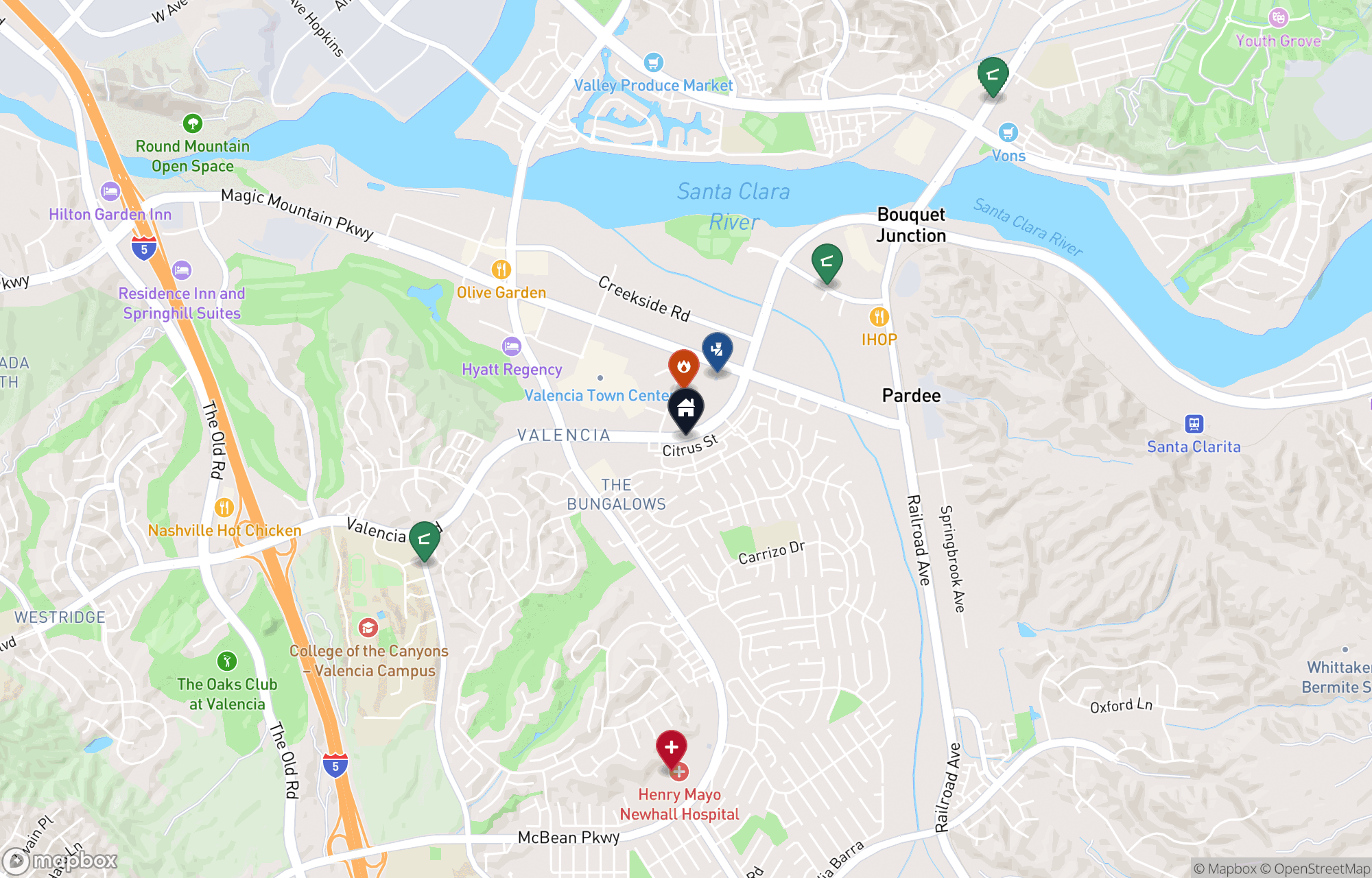
Officials decide evacuation routes when it happens, and they can change by the hour. Follow their directions first. These maps help you know your area and your options ahead of time, including if phones and GPS are down.
Your Neighborhood
Home (black), with the nearest hospitals (red), fire stations (orange), police (blue) and possible shelter sites (green). About 4.3 miles across.
Major Routes Out
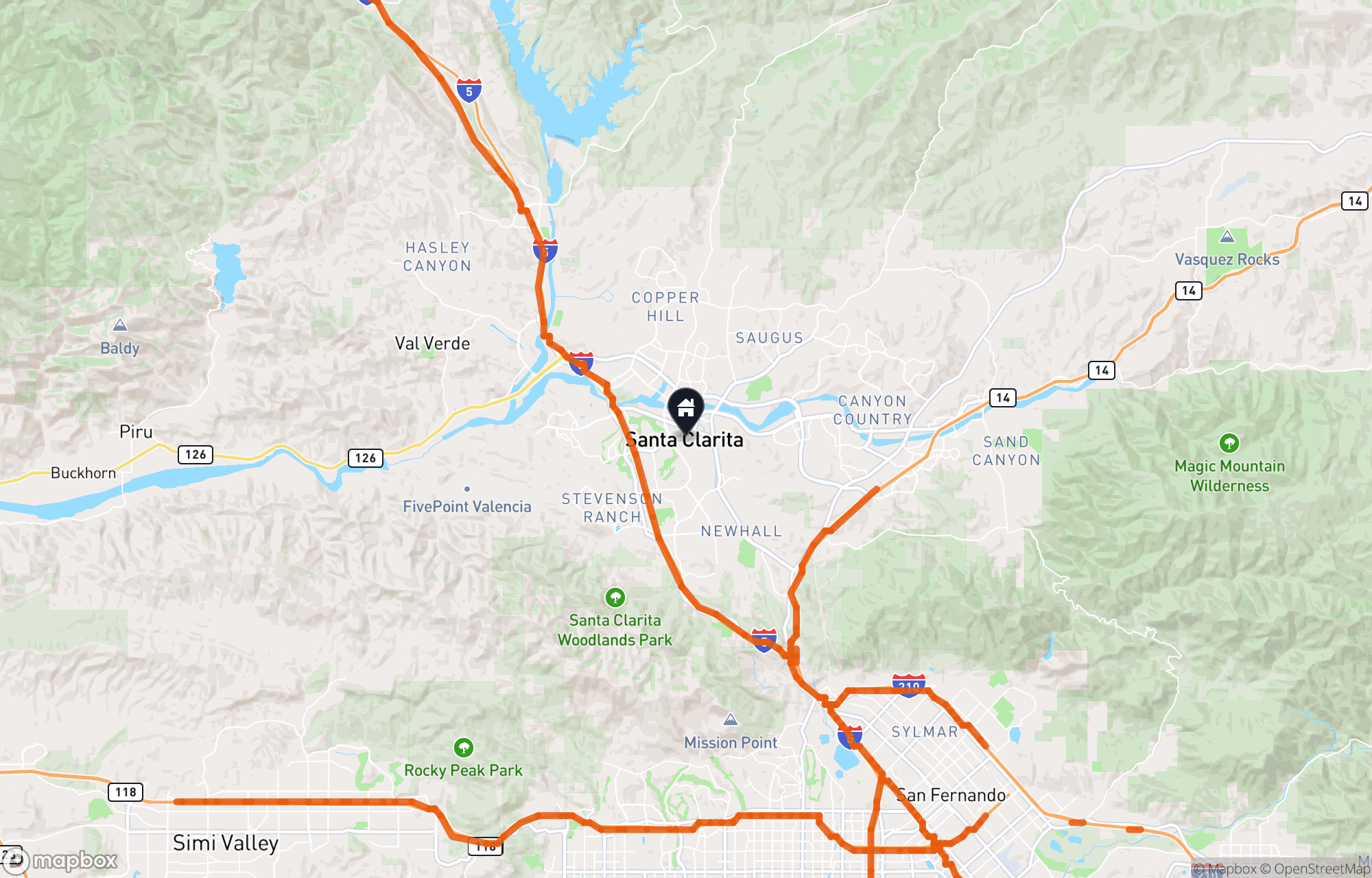
Freeways and highways near you, in orange. Know two ways out in different directions: the closest one may be closed or jammed.
Major Roads Near You
Route
Name
Nearest point
I-5
Golden State Fwy
1.4 mi W
CA-14
4.2 mi SE
I-210
Foothill Fwy
7.5 mi SE
CA-118
San Fernando Valley Fwy
9.5 mi S
I-405
San Diego Fwy
9.7 mi SE
CA-170
Hollywood Fwy
14.9 mi SE
Valencia Blvd
Main road
At your door
Bouquet Canyon Rd
Main road
0.7 mi E
Soledad Canyon Rd
Main road
1 mi NE
Plan two ways out in different directions, and drive them once so you know them. Keep a paper road map in the car: a printed copy of these maps is a good start. Fill your tank when it drops to half during fire or storm season.
Possible Shelter Locations (Open Only When Officials Announce It)
The Church On The Way23415 Cinema Drive, Santa Clarita
0.7 mi NE
College Of The Canyons, West Phys. Education26455 Rockwell Canyon Rd, Valencia · wheelchair accessible
0.9 mi SW
Santa Clarita United Methodist Church26640 Bouquet Canyon Rd., Santa Clarita
1.4 mi NE
Fellowship Hall At Christ Lutheran Church25816 Tournament Road, Santa Clarita
1.6 mi S
Valencia High School Main Gym27801 N Dickason Drive, Santa Clarita · wheelchair accessible
1.9 mi N
Helipads
Los Angeles County Sheriff HelipadHelipad
0.2 mi NE
Henry Mayo Newhall Hospital HeliportHelipad
1.0 mi S
Henry Mayo HospitalHelipad
1.0 mi S
Source: OpenStreetMap contributors. Shelters open only when local officials activate them; check your county’s alerts or call 211.
Who to Call and Where to Get Alerts
State emergency managementCalifornia Governor's Office of Emergency Services (Cal OES)916-845-8506caloes.ca.gov ↗
Local alertsSign up for your county’s alertscalalerts.org ↗Cal OES list of every California county’s alert system (text, email and phone alerts for evacuations).
County emergency managementLos Angeles County Office of Emergency ManagementFind your county’s office ↗Find your county’s office and sign up for its alerts (many counties use text and email alerts for evacuations).
Wireless alertsTurn on Emergency Alerts on your phoneiPhone: Settings → Notifications → Government Alerts. Android: Settings → Safety & emergency → Wireless emergency alerts.
Your Family Emergency Plan
Fill this in together, then keep a copy in each go-bag and on the fridge. Phone lines jam in big emergencies: plan to text first.
Meeting place near home (e.g. a neighbor’s driveway)
Meeting place outside the neighborhood
Out-of-area contact (name and phone): everyone texts this person
Where we go if we must evacuate (friend, family, hotel)
School / daycare pickup plan
Work locations and plans
Medical needs, medications and doctors
Pets: carrier, food and where they can stay
Who turns off gas, water and electricity (and where the shutoffs are)
Utilities and Shut-Offs
ElectricitySouthern California Edison CoCheck your bill to be sure. Outages and alerts ↗
Natural gasSouthern California GasCheck your bill to be sure. Outages and alerts ↗
WaterSanta Clarita Valley Water AgencyCheck your bill to be sure. Outages and alerts ↗
Write each company’s emergency and outage phone numbers in your family plan: they’re on your bills and the company websites.
Find your gas, power and water shut-offs now, while it’s calm, and show everyone old enough to use them. Keep the tools next to each one or in your home kit. In a disaster, a broken gas line, a sparking circuit or a burst pipe can turn into a fire, a shock or a flood in minutes.
Tools to Keep Ready
A 12 to 15 inch adjustable wrench, or a 4-in-1 gas and water shut-off tool. Tie it to the gas pipe or keep it in a marked spot nearby.
A water meter key (curb key), if your water shut-off is in a box at the street.
A flashlight or headlamp with fresh batteries (never a candle or lighter near gas).
Work gloves and sturdy shoes; dry, rubber-soled shoes for the electrical panel.
Tags or tape to label each shut-off, and your utility companies’ phone numbers.
Natural Gas
When to Shut It Off
You smell gas (a rotten-egg smell), hear hissing or blowing, or see a broken gas line.
Officials or your gas company tell you to.
Don’t shut it off just because there was an earthquake or a storm. If there are no signs of a leak, leave it on: once it’s off, it can take days to get turned back on.
How
If you smell gas inside, get everyone out first. Don’t flip light switches, use phones, start a car in an attached garage, or light anything on the way out.
Find the shut-off valve on the pipe that comes out of the ground into the gas meter, usually 6 to 8 inches above the ground.
Use the wrench to give the valve a quarter turn, either way. Gas is off when the flat tab on the valve points across the pipe, not along it.
From a safe distance outside, call your gas company or 911. Leave doors open as you go if it’s safe to.
Propane: turn the valve on top of the tank clockwise (to the right) to close it.
Afterwards
Never turn the gas back on yourself. The gas company or a licensed professional has to check for leaks and relight pilot lights.
Some homes have an automatic seismic shut-off valve or a smart meter that closes in an earthquake. Know if you have one: it also needs a professional to reset safely.
You see sparks or arcing, smell burning insulation, or switches and outlets are blackened or hot.
Water is rising toward outlets, the panel or appliances, or there’s a fire or a big leak inside.
Officials tell you to before you evacuate, or wiring was damaged in an earthquake.
During a long outage, switch off or unplug computers and appliances so a power surge doesn’t damage them when power returns. Leave one light on so you know when it’s back.
How
Find the main electrical panel: usually in the garage, a utility closet, the basement, or outside next to the electric meter.
Never touch the panel if the floor is wet or you’re standing in water. Leave and call the electric company.
Turn off the smaller (branch) circuit breakers one at a time, then the large breaker marked MAIN, usually at the top. Turning them off in that order avoids a spark at the main switch.
Older homes may have a fuse box: pull out the main fuse block by its handle.
Use a flashlight, not candles.
Afterwards
Stay at least 35 feet from downed power lines and anything touching them, and call 911. Treat every downed line as live.
Never plug a generator into a wall outlet (it can kill utility workers). Use heavy extension cords, or a transfer switch installed by an electrician, and run the generator outside, at least 20 feet from doors and windows.
Turn the main back on first, then the branch breakers one at a time. Have an electrician check anything that got wet.
After an earthquake, or when officials report broken water mains or a boil-water notice. Closing the main keeps dirty water out of your pipes and saves the clean water already in your water heater (often 30 to 80 gallons) for drinking.
How
Find the main shut-off where the water line enters the house: often in the garage, the basement, a utility closet, or on an outside wall near a hose faucet.
A round handle (gate valve): turn it clockwise (to the right) until it stops. A lever (ball valve): turn it a quarter turn so it points across the pipe.
If you can’t find one at the house, the shut-off is at the water meter, usually in a box at the curb. Open the lid and turn the valve a quarter turn with a water meter key.
Open a faucet at the lowest point of the house to check that the water has stopped.
Afterwards
To use the water heater’s water: turn off its gas or power first, open a hot-water faucet upstairs to let air in, then drain from the valve at the bottom into clean containers.
Turn the main back on slowly, a little at a time, and run cold taps until the air is out. Follow any boil-water notice until officials lift it.
Practice once a year: old valves seize. If yours won’t turn, have a plumber replace it now.
Sources: electric service territories (EIA, via Pacific Northwest National Laboratory); community water system boundaries (US EPA); natural gas service areas (California Energy Commission).
Supplies for 5 People and 1 Pet
16 galwater for 3 days (go-bags)
74 galwater for 2 weeks at home
2 weeksof food at home for each person (70 days’ worth for 5 people), plus pet food
Water
You can live weeks without food but only a few days without water. After an earthquake, fire or flood, tap water may stop or may not be safe to drink.
Plan on 1 gallon per person per day: about half a gallon for drinking and half for cooking and basic washing. Bare minimum: at least a 3-day supply for each person (3 gallons per person). Home goal: a 2-week supply (14 gallons per person). In California earthquake country, 2 weeks is the target. Store more if someone is nursing, sick, older, a child, or if it is hot. Hot weather can double how much people need. Pets need water too. A rough rule is about 1 ounce of water per pound of body weight per day. A 50-pound dog needs about half a gallon a day.
Buy sealed, store-bought bottled water. It is the safest choice. Keep it in its original container and do not open it until you need it.
Check the expiration or "best by" date and swap it out before then.
If you fill your own containers, use food-grade water containers or clean 2-liter soda bottles. Never use milk jugs (they break down and are hard to clean) or anything that held chemicals.
To clean a container: wash with soap and water and rinse. Then swish a mix of 1 teaspoon of unscented household bleach in 1 quart of water around the inside, empty it, and let it air-dry or rinse with clean water.
Fill with tap water from a safe public supply, cap tightly, and label with the date. Replace home-filled water every 6 months.
Store water in a cool, dark place, away from sunlight, gasoline, pesticides and other chemicals.
If you run out and the water may be unsafe, boil it first: bring it to a rolling boil for 1 minute (3 minutes if you live above 6,500 feet). Let it cool before drinking.
If you cannot boil, use plain, unscented household bleach that says 6% or 8.25% sodium hypochlorite on the label. Add 8 drops of 6% bleach or 6 drops of 8.25% bleach per gallon of clear water. Stir and wait 30 minutes. It should smell slightly of chlorine. If it does not, repeat and wait another 15 minutes.
If the water is cloudy, let it settle and filter it through a clean cloth or coffee filter first, then use double the bleach.
Do not use scented, color-safe, or "splash-less" bleach, and do not use pool chemicals to treat drinking water.
Hidden water in your home: the water heater tank, ice cubes, and the water in pipes. Turn off the main water valve first if there are reports of broken lines so dirty water does not get in. Never drink water from toilet tanks treated with cleaners, waterbeds, or pools.
Tips
Know where your main water shut-off valve is and how to turn it.
A portable water filter is helpful, but most filters do not remove viruses or chemicals. Boiling or bleach handles germs.
Bleach slowly loses strength. Replace your bottle of bleach about once a year.
Do not ration drinking water. Drink what you need today and look for more tomorrow.
Stores may close and power may be out for days. Food that does not need a refrigerator or much cooking keeps everyone fed and calm.
Bare minimum: at least a 3-day supply of non-perishable food for each person. Home goal: a 2-week supply for each person. Pets: at least a 2-week supply of their food at home, and 3 days in the go bag. Infants: enough formula and baby food for 2 weeks at home. Ready-to-feed formula is best because it does not need water.
Pick foods your family already eats: canned meats, fish, beans, soups, fruit and vegetables; peanut butter; crackers; cereal; granola and protein bars; dried fruit and nuts; shelf-stable milk.
Choose foods that need no cooking and little water. Avoid very salty foods that make you thirsty.
Keep a manual can opener with the food.
Write the date on everything. Use the oldest food first and replace it as you go ("first in, first out").
Store food in a cool, dry, dark place. Keep boxes in sealed plastic or metal bins to keep out pests.
When the power goes out, keep the refrigerator and freezer doors closed. A closed fridge keeps food cold about 4 hours. A full freezer stays frozen about 48 hours (about 24 hours if half full).
Throw out meat, fish, eggs, milk, leftovers and other perishable food that has been above 40°F for 2 hours or more. Never taste food to see if it is safe. When in doubt, throw it out.
Throw out any food that touched flood water, and any can that is swollen, dented at the seam, or leaking.
Tips
Keep an appliance thermometer in your fridge and freezer so you know the real temperature.
Plan for special diets, food allergies, and soft foods for anyone with dental problems.
Comfort foods and treats help children (and adults) cope.
Cook only outdoors with a grill or camp stove. Never use them inside, even in a garage.
After a big earthquake, toilets may not flush and sewer lines may be broken. Keeping clean and handling waste safely stops illness from spreading.
Toilet paper: about 1 roll per person every 5 days (3 rolls per person for 2 weeks). Heavy-duty (3 mil or thicker) trash bags: about 2 per person per day if you use a bucket toilet. Hand sanitizer, soap, moist towelettes, and feminine supplies for 2 weeks. Diapers: about 8 to 10 per infant per day (fewer for older babies).
Do not flush until you know the sewer lines are OK. Listen for news from your city or water district.
Make a bucket toilet: line a 5-gallon bucket (or your empty toilet bowl) with two heavy trash bags. After each use, add a scoop of kitty litter, sawdust, or a small amount of bleach to control smell and germs.
Tie bags closed when about half full. Store them in a second covered bucket or a lidded trash can away from people and water, until trash pickup is back.
Wash hands with soap and clean water, or use hand sanitizer with at least 60% alcohol when water is short.
Keep a small hygiene kit for each person: toothbrush, toothpaste, deodorant, comb, and any personal items.
Tips
Store the bucket toilet supplies together, inside the bucket, so they are ready.
Never mix bleach with ammonia or other cleaners.
No-rinse body wash and shampoo save a lot of water.
Nights can get cold, even in Southern California, and you may have no heat. Using the wrong heater indoors can kill you with carbon monoxide or start a fire.
1 warm blanket or sleeping bag per person. 1 complete change of warm clothing per person, including a hat, long pants, long sleeves, and sturdy closed-toe shoes. 1 emergency (mylar) blanket and 1 rain poncho per person in each go bag. Plastic sheeting and duct tape to cover a broken window, and work gloves for each adult.
Dress in layers. Wear a hat. Stay in one room, close the doors, and cover windows with blankets at night.
Never use a gas oven or stove to heat your home.
Never use a grill, camp stove, charcoal, or a gas generator inside your home, garage, basement, or tent, even with windows or doors open.
If you use a space heater, use one with automatic shut-off, keep it at least 3 feet from anything that can burn, plug it straight into a wall outlet (not an extension cord), and turn it off when you leave the room or go to sleep.
Only use a fireplace or wood stove if the chimney is clean and not damaged. After an earthquake, have it checked before lighting a fire.
Put carbon monoxide (CO) alarms with battery backup on every level of your home and outside sleeping areas. Test them monthly.
CO has no smell or color. Headache, dizziness, weakness, upset stomach, confusion, or chest pain can be signs. If you suspect CO or an alarm sounds, get everyone outside to fresh air right away and call 911.
Tips
If it is too cold to stay safely at home, go to a warming center or a friend's home.
Check on older neighbors and people who live alone.
In hot weather, the danger is heat. Plan a cool place to go, and never leave people or pets in a parked car.
Earthquakes, storms, wildfires, and planned Public Safety Power Shutoffs can leave you without power for days. Light, a radio, and a way to charge phones matter most.
1 flashlight or headlamp per person, plus 1 battery lantern for the house. 2 full sets of spare batteries for every device, or rechargeable lights with a charged power bank. 1 battery-powered or hand-crank radio with NOAA Weather Radio bands per household. 1 phone power bank per adult (10,000 mAh or more charges most phones 2 to 3 times). Anyone who uses powered medical equipment needs backup power for at least 3 days, and a plan for 2 weeks.
Use flashlights and lanterns, not candles. Candles start many fires after disasters.
Unplug TVs, computers and other electronics when the power goes out, to protect them from a power surge when it comes back. Leave one light switched on so you know when power returns.
Keep phones charged and turn on low-power mode. Text instead of calling. Texts get through more often when networks are busy.
Charge devices in your car only with the car parked outside, never in a closed garage.
Generators: run them only outdoors, at least 20 feet from any window, door, or vent, and pointed away from the house. Never run one in a garage, carport, basement, or crawl space, even with the door open.
Plug appliances into the generator with heavy-duty, outdoor-rated extension cords. Never plug a generator into a wall outlet ("backfeeding"). It can kill utility workers and neighbors. A permanent hookup needs a transfer switch put in by a licensed electrician.
Turn the generator off and let it cool before adding fuel. Store fuel in approved containers, outside your living space.
Keep the generator dry, under an open canopy, and never touch it with wet hands.
If you rely on medical devices or refrigerated medicine, tell your power company. Ask your doctor how long your medicine stays good without refrigeration.
Tips
A small solar panel or solar lantern can recharge phones and lights for many days.
Know how to open your garage door by hand.
Keep your car's gas tank at least half full. Gas pumps need power.
Sign up for outage alerts from your power company.
After a disaster, help may take hours or days to reach you. A stocked first aid kit, knowing basic first aid and CPR, and enough medicine can save a life.
1 well-stocked first aid kit at home, and a smaller one in each car and go bag. At least a 7-day supply of each prescription medicine in the go bag, and a 2-week supply at home if your doctor and pharmacy allow. A written list of every medicine, dose, allergy, and doctor for each person. Spare glasses, hearing aid batteries, and medical supplies (like test strips or inhaler) for each person who needs them.
Ask your doctor or pharmacist about getting an extra supply of medicine for emergencies and how to store it.
Check expiration dates every 6 months. Rotate medicines so the newest go into the kit.
Learn hands-only CPR: if a teen or adult suddenly collapses and is not breathing normally, call 911, then push hard and fast in the center of the chest, about 100 to 120 pushes a minute, until help arrives or an AED is ready.
Use an AED (automated external defibrillator) as soon as one is available. Turn it on and follow its voice directions.
For heavy bleeding: call 911, press hard on the wound with a cloth or gauze, and keep pressing. If bleeding from an arm or leg will not stop, use a tourniquet above the wound if you have one and know how.
For burns: cool with cool (not ice-cold) running water for at least 10 minutes, then cover loosely with a clean, dry cloth.
Take a first aid and CPR class. Many are free or low cost and take a few hours.
Tips
Store medicines in a waterproof bag in a cool, dry place.
Children's doses are based on weight. Write each child's weight and dose on the medicine label or list.
Keep a copy of the medicine list on your phone and on paper.
Phones and the internet may be overloaded or down. Your family needs a way to get warnings, check in with each other, and know where to meet.
1 battery or hand-crank radio with NOAA Weather Radio per household. 1 paper contact card for each person, with family phone numbers and an out-of-area contact. 1 whistle per person to signal for help. Optional: a pair of FRS or GMRS two-way radios (one per adult or older child) with spare batteries.
Pick an out-of-area contact, a friend or relative in another state. Long-distance calls and texts often get through when local ones do not. Everyone checks in with that person.
Pick two meeting places: one just outside your home (for a fire) and one outside your neighborhood (if you cannot go home).
Write it all down on a paper card. Phones die and you may not remember numbers.
Turn on Wireless Emergency Alerts in your phone settings, and sign up for your county's emergency alerts.
Send short texts instead of calling. Keep calls short so the network stays open for others.
If you are trapped, blow a whistle in sets of three, or tap on a pipe or wall. Shouting wastes energy and can make you breathe in dust.
See the "Radio when phones are down" page for radio channels and a family radio plan.
Tips
Helpful free apps: FEMA app (alerts and shelter info), MyShake (California earthquake early warning), Watch Duty (wildfire information), and Genasys Protect (evacuation zones used by many California counties). Know your evacuation zone before you need it.
Check scvrescue.org for the apps and checklists our search and rescue volunteers recommend.
Download offline maps of your area onto your phone.
If you have to leave fast, you will need proof of who you are, where you live, and what you own to get help, file insurance claims, and refill prescriptions. Card readers and ATMs may not work without power.
1 set of copies of important papers per household, in a waterproof bag or folder. Cash in small bills (ones, fives, tens and twenties). Enough for a few days of gas, food, and supplies. A digital backup of your papers, stored securely (encrypted file or a trusted cloud account).
Make copies of: photo IDs, birth certificates, passports, Social Security cards, insurance policies (home, renter, car, health), house deed or lease, car titles, bank account numbers, wills and powers of attorney, prescriptions, medical cards and vaccination records, and pet records.
Put the copies in a waterproof, fire-resistant bag and keep it in or near your go bag.
Take photos or a video of each room of your home and your valuables for insurance.
Add a list of phone numbers: family, out-of-area contact, doctors, pharmacy, vet, insurance, utilities, landlord.
Keep originals in a safe place, like a fire-safe box or safe deposit box.
Update the copies and cash once a year.
Tips
Do not keep a full list of passwords on paper in the go bag. If it is lost, someone could use it.
Keep a spare house key and car key in the go bag.
Store your insurance company's claim phone number in your phone and on paper.
Amounts are worked out for your household. Tick items off as you pack.
Go Bag (72 Hours)
One backpack per person, packed and by the door, so you can leave in minutes for a wildfire or other evacuation. It holds what you need for 3 days away from home. Adults carry the heavy items. Each child old enough should carry a small bag of their own.
Drinking water15 gallonsHeavy: 8 lb a gallon. Carry what you can; keep the rest in the car.
Water for pets1.5 gallonsAbout 1 oz per pound of body weight a day. Less for cats and small pets.
Ready-to-eat food3-day supply for 5 peopleBars, nut butter, jerky, dried fruit, crackers. No cooking needed.
Pet food3-day supplyIn a sealed container, with a collapsible bowl.
Prescription medicines7-day supply for each personFor each person who takes daily medicine. Keep in original bottles.
Flashlight or headlamp× 5Headlamps keep hands free.
Spare batteries2 setsSized for every light and radio you pack.
Battery or hand-crank radio with NOAA weather bandMany also charge a phone.
Phone power bank and cable× 3Keep it charged. Check monthly.
First aid kit (small)See the first aid kit list.
N95 masks× 15For wildfire smoke and dust. Child sizes exist.
Copies of important documents1 setIn a waterproof bag. IDs, insurance, medical and pet records.
Cash in small bills1 envelopeATMs and card readers may be down.
Paper contact card× 5Family numbers, out-of-area contact, meeting places.
Medication list and doctor contactsDoses, allergies, conditions, and medical devices used.
Spare eyeglasses1 pairPack a pair for anyone in the home who wears glasses.
Leash, harness, or pet carrierShelters usually require pets to be leashed or crated.
Pet ID tag, photo, and vaccine records1 setA photo of you with your pet helps prove ownership.
Whistle× 5Three blasts means help.
Change of clothes5 setsLong sleeves, long pants, socks, warm layer, hat.
Sturdy closed-toe shoes5 pairsBroken glass is common after earthquakes.
Hearing aid batteries1 packOr a charger and power bank for rechargeable aids.
Pet medicines7-day supplyIf your pet takes any.
Emergency (mylar) blanket× 5Light and small.
Rain poncho× 5
Water filter or purification tabletsIn case you run out of stored water.
Personal hygiene kit× 5Toothbrush, toothpaste, deodorant, feminine supplies.
Hand sanitizer1 bottleAt least 60% alcohol.
Toilet paper and moist towelettes1 pack
Trash bags× 3Also work as rain covers or ground sheets.
Pet waste bags× 10Add a small litter pan for cats.
Folding cane or other mobility aid backupIf someone uses a walker, cane, or wheelchair.
Comfort item or small game× 2A stuffed animal, book, or cards.
Spare house and car keys1 set
Local paper mapMark your meeting places and two ways out.
Multi-tool and work gloves3 sets
Home Kit (2 Weeks)
Supplies to shelter in place at home for 2 weeks with no power, no running water, and no stores. Keep it in bins in a closet or garage you can reach after an earthquake.
Drinking water70 gallonsStore-bought, sealed. Replace by the date on the label.
Water for pets7 gallonsAbout 1 oz per pound of body weight a day. Adjust for pet size.
Non-perishable food14-day supply for 5 peopleCanned and dry foods your family eats. Rotate oldest first.
Pet food14-day supplyIn an airtight container.
Manual can opener
Prescription medicines14-day supply for each personFor each person who takes daily medicine. Ask your doctor about an extra supply.
First aid kit (full)See the first aid kit list.
Flashlight or headlamp× 5Keep one by each bed.
Battery lantern× 2Never use candles.
Spare batteries3 setsFor every light, radio, and medical device.
Battery or hand-crank radio with NOAA weather band
Phone power bank× 3A solar charger helps for long outages.
Carbon monoxide alarm with battery backupOne on every level and outside sleeping areas.
Fire extinguisher (ABC type)Learn how to use it.
Wrench to turn off gas and waterShut off gas only if you smell gas or hear a hiss.
Toilet paper15 rolls
Bucket toilet kit1 kitTwo 5-gallon buckets with lids, kitty litter or sawdust.
Heavy-duty trash bags× 1403 mil or thicker, for the bucket toilet and trash.
Unscented household bleach1 bottle6% or 8.25%. For treating water and cleaning. Replace yearly.
Blanket or sleeping bag× 5
Warm clothes and sturdy shoes5 setsKeep shoes under the bed for nighttime earthquakes.
Spare eyeglasses1 pairAnd for anyone else who wears glasses.
Backup power for medical devicesBatteries for oxygen, CPAP, or power wheelchair. Ask the supplier.
Medication list and doctor contactsTaped inside the kit lid.
Pet litter and pan, or waste bags1 set
Pet carrier or crateLabel with your name and phone.
Hearing aid batteries2 packs
Incontinence and personal care supplies2-week supplyIf needed.
Hand sanitizer and soap2 bottles
Personal hygiene kit× 5Toothbrush, toothpaste, feminine supplies, no-rinse wash.
N95 masks× 25For smoke, dust, and cleanup.
Plastic sheeting and duct tape1 setTo cover broken windows.
Work gloves3 pairsLeather, for broken glass and debris.
Paper plates, cups, and utensils1 packSaves water for washing.
Camp stove or grill with fuelOutdoors only. Never indoors or in a garage.
Games, books, and comfort items2 setsHelps children cope.
Cash and document copies1 setIf not already in your go bag.
Car Kit
Keep these in each car in case you get stuck on the road, have to evacuate while away from home, or have a breakdown in the heat or mountains. Keep the gas tank at least half full.
Drinking water5 gallonsReplace every 6 months; heat breaks down plastic bottles.
Water for pets0.5 gallonIf pets ride with you.
Energy bars or other no-cook food1-day supply for 5 peopleChoose foods that handle heat.
First aid kit (small)
Flashlight with spare batteries
Phone car charger and cable
Jumper cables or jump starterA battery jump starter works without another car.
Reflective triangles or road flares× 3Do not use flares in dry grass.
Emergency blanket× 5
Prescription medicines1-day supply for each personOnly for those who need daily medicine. Mind heat limits.
Spare eyeglasses1 pairEspecially for driving.
Leash and collapsible bowl1 set
Paper mapPhones and GPS may not work.
Whistle
N95 masks× 10For wildfire smoke.
Tire inflator and flat repair kitCheck your spare tire too.
Seat belt cutter and window breakerWithin reach of the driver.
Small fire extinguisherRated for vehicles (BC or ABC).
Work gloves3 pairs
Rain poncho× 5
Sun hat and sunscreen1 set
Small folding shovelFor mud, sand, or snow.
Tire chains and ice scraper1 setIf you drive in the mountains in winter.
Toilet paper, wipes, and trash bags1 set
Cash in small bills1 envelope
Duct tape and multi-tool1 set
First Aid Kit
A home first aid kit sized to your household. Keep it in a waterproof box that is easy to carry, check it every 6 months, and replace what you use. Supplies do not replace training: take a first aid and CPR class.
First aid guide bookletYou may not have internet.
Disposable non-latex gloves4 pairsProtects you and the injured person.
Adhesive bandages, assorted sizes× 50
Sterile gauze pads, 4 x 4 inch× 10
Sterile gauze pads, 3 x 3 inch× 5
Large wound dressings (5 x 9 inch or trauma pads)× 2For heavy bleeding.
Tourniquet (commercial)For life-threatening limb bleeding. Learn how in a Stop the Bleed class.
Roller gauze bandages (3 and 4 inch)2 rolls
Medical adhesive tape1 roll
Antiseptic wipes× 10
CPR face shield or breathing barrier
Trauma shears or scissors
TweezersFor splinters and glass.
Emergency (mylar) blanket× 2Helps prevent shock and hypothermia.
Personal medicines and allergy list× 5Include any prescribed epinephrine auto-injector or inhaler.
Triangular bandages× 2Make a sling or hold a dressing.
Elastic (ACE) bandageFor sprains.
Antibiotic ointment packets× 5
Hydrocortisone cream packets× 2For itching and rashes.
Burn gel or burn dressing× 2Cool burns with water first.
Instant cold packs× 2
Thermometer
Adult pain and fever reliever3 small bottlesAcetaminophen or ibuprofen.
Chewable aspirin, 81 mg1 packAdults only. Ask your doctor whether it is right for you.
Children's pain and fever reliever2 bottlesDose by weight. Never give aspirin to children.
Antihistamine1 packFor allergic reactions. Not a substitute for epinephrine.
Oral rehydration salts4 packetsFor heat illness and diarrhea.
Saline eye wash1 bottleFor dust, smoke, and debris.
Moldable splint
Glucose tablets or gel1 packFor low blood sugar; include for anyone with diabetes.
Pet first aid supplies1 setSelf-stick vet wrap, gauze, soft muzzle, vet's phone number.
Hand sanitizer1 bottle
Safety pins and resealable bags1 set
Radio When Phones Are Down
Your NOAA Weather Radio: WNG584 162.525 MHz (Avalon, covers extreme west part); WNG659 162.425 MHz (El Paso Mtns., covers n part); KWO37 162.550 MHz (Los Angeles); KWL22 162.425 MHz (Malibu Marine); WZ2505 162.425 MHz (Sandberg, covers north central part). SAME code for your county: 006037
Local Police, Fire and EMS Channels
During a disaster, listening to local dispatch can tell you what responders are doing before the news does. We can’t list local channels here: the channel names and uses (dispatch, tactical, command) come from volunteer-built databases we don’t have the right to republish. These two free sites have them for Los Angeles County:
Write your county’s sheriff, police and fire dispatch channels into your family radio plan below. Plain “FM” channels work on any scanner; “P25” or other digital channels need a digital scanner, and trunked systems need a trunking scanner. Broadcastify plays many of them online with no scanner at all. Check your state’s rules before using a scanner in a vehicle.
National Emergency Channels
When a disaster brings in responders from other places, many of them talk on these shared national channels. They’re worth programming into a scanner anywhere in the US. Listening only: transmitting on them needs an FCC licence.
Fire, EMS and Law Enforcement Mutual Aid (VHF)
Used when agencies from different places work the same incident, such as a large wildfire.
Channel
MHz
Use
VFIRE21
154.2800
Fire mutual aid
VFIRE22
154.2650
Fire mutual aid
VFIRE23
154.2950
Fire mutual aid
VFIRE24
154.2725
Fire mutual aid
VFIRE25
154.2875
Fire mutual aid
VFIRE26
154.3025
Fire mutual aid
VMED28
155.3400
EMS mutual aid; ambulance to hospital in many areas
VMED29
155.3475
EMS mutual aid
VLAW31
155.4750
Law enforcement mutual aid
VLAW32
155.4825
Law enforcement mutual aid
Search and Rescue
Ground teams, and aircraft helping with searches or in distress. Aircraft channels use AM: set your scanner to AM for them.
Channel
MHz
Use
VSAR16
155.1600
Search and rescue teams (national SAR channel)
Aircraft emergency
121.5000
Aircraft distress and emergency (AM)
SAR air-to-ground
123.1000
Search and rescue aircraft (AM)
American Red Cross
Red Cross disaster teams. On almost every Red Cross radio licence in the FCC database. Low band: needs a scanner that covers 30 to 50 MHz.
Channel
MHz
Use
Red Cross national
47.4200
Disaster operations, nationwide
Red Cross secondary
47.5000
Disaster operations, nationwide
National Interoperability Calling and Tactical Channels
Shared by every kind of agency nationwide; the calling channels are where responders first make contact.
Channel
MHz
Use
VCALL10
155.7525
VHF calling
VTAC11
151.1375
VHF tactical
VTAC12
154.4525
VHF tactical
VTAC13
158.7375
VHF tactical
VTAC14
159.4725
VHF tactical
UCALL40
453.2125
UHF calling
UTAC41
453.4625
UHF tactical
UTAC42
453.7125
UHF tactical
UTAC43
453.8625
UHF tactical
7CALL50
769.24375
700 MHz calling (digital)
7CALL70
773.25625
700 MHz calling (digital)
8CALL90
851.0125
800 MHz calling
8TAC91
851.5125
800 MHz tactical
8TAC92
852.0125
800 MHz tactical
8TAC93
852.5125
800 MHz tactical
8TAC94
853.0125
800 MHz tactical
UHF MED Channels (Ambulance and Hospital)
Paramedics use these to talk with hospitals; MED-9 and MED-10 are often EMS dispatch.
After a big earthquake or wildfire, cell towers can lose power or get overloaded. Radio still works. A simple receive-only radio lets you hear official warnings. Two-way radios let your family talk across a neighborhood without any network at all.
Start with listening: get a NOAA Weather Radio or an AM/FM radio with weather band. This is the most important radio you can own.
For family talk, a pair of FRS radios needs no license and works across a few blocks.
For more range, GMRS radios need an easy FCC license (no test) that covers your family.
Write a family radio plan (see the template at the end) and practice it.
Radio range is much shorter than the box says. Hills, buildings, and trees block signals. Expect a few blocks to a mile or two with handheld radios in town.
Keep radios charged and store spare batteries. Turn radios off when not in use to save power.
Your local AM/FM news station is part of the Emergency Alert System. Know which station serves your area.
NOAA Weather Radio All Hazards is a nationwide network of radio stations run by the National Weather Service. It broadcasts weather forecasts and warnings 24 hours a day, plus alerts for other hazards like earthquakes, chemical spills, and AMBER alerts when officials request it. You can only listen; you cannot transmit on it.
Channel (common label)
Frequency (MHz)
1 (WX1)
162.550
2 (WX2)
162.400
3 (WX3)
162.475
4 (WX4)
162.425
5 (WX5)
162.450
6 (WX6)
162.500
7 (WX7)
162.525
Buy a weather radio with battery backup and the "Public Alert" or SAME feature. Many crank and solar radios include the weather band.
Scan the 7 weather channels and pick the one that comes in clearest. You may hear more than one station.
Look up your county's SAME code at weather.gov/nwr/counties (or call 1-888-NWR-SAME). Enter it in the radio so it only wakes you for alerts in your area.
SAME (Specific Area Message Encoding) codes are 6 digits. In California they start with 006 plus a 3-digit county number. For example, Los Angeles County is 006037. Check the exact code on the NWS site.
Set the radio to alert mode. It stays quiet until a warning comes in, then sounds an alarm.
Test it once a month. The National Weather Service sends a weekly test, usually on Wednesdays.
Radio makers do not all number the channels the same way. Always go by the frequency.
Coverage is not perfect in canyons and mountains. Check reception where you live.
Weather radios with special alerting are available for people who are deaf or hard of hearing (strobe lights, bed shakers).
FRS (Family Radio Service) and GMRS (General Mobile Radio Service) radios are the walkie-talkies sold in stores. They share the same 22 channels. FRS radios need no license and are limited to low power. GMRS radios can use more power, detachable antennas, and repeaters, but you need an FCC license.
Channel
Frequency (MHz)
Who can use it
FRS max power
GMRS max power
1
462.5625
Shared FRS and GMRS
2 watts
5 watts
2
462.5875
Shared FRS and GMRS
2 watts
5 watts
3
462.6125
Shared FRS and GMRS
2 watts
5 watts
4
462.6375
Shared FRS and GMRS
2 watts
5 watts
5
462.6625
Shared FRS and GMRS
2 watts
5 watts
6
462.6875
Shared FRS and GMRS
2 watts
5 watts
7
462.7125
Shared FRS and GMRS
2 watts
5 watts
8
467.5625
Shared, low power only
0.5 watt
0.5 watt
9
467.5875
Shared, low power only
0.5 watt
0.5 watt
10
467.6125
Shared, low power only
0.5 watt
0.5 watt
11
467.6375
Shared, low power only
0.5 watt
0.5 watt
12
467.6625
Shared, low power only
0.5 watt
0.5 watt
13
467.6875
Shared, low power only
0.5 watt
0.5 watt
14
467.7125
Shared, low power only
0.5 watt
0.5 watt
15
462.5500
Shared; GMRS high power and repeaters
2 watts
50 watts
16
462.5750
Shared; GMRS high power and repeaters
2 watts
50 watts
17
462.6000
Shared; GMRS high power and repeaters
2 watts
50 watts
18
462.6250
Shared; GMRS high power and repeaters
2 watts
50 watts
19
462.6500
Shared; GMRS high power and repeaters
2 watts
50 watts
20
462.6750
Shared; GMRS high power and repeaters
2 watts
50 watts
21
462.7000
Shared; GMRS high power and repeaters
2 watts
50 watts
22
462.7250
Shared; GMRS high power and repeaters
2 watts
50 watts
FRS: buy a pair of FRS radios and use them right away. No license is needed. They are the simplest choice for most families.
GMRS: if you want more range (higher power, a car radio, or a repeater), get a GMRS license from the FCC online. There is no test.
The GMRS license costs $35 (the FCC fee as of this writing) and lasts 10 years. Check fcc.gov for the current fee before you apply.
One GMRS license covers you and your immediate family members, such as your spouse, children, grandchildren, parents, grandparents, brothers and sisters, aunts and uncles, nieces and nephews, and in-laws. You must be at least 18 to hold the license.
To apply: create an FCC Registration Number (FRN) in the FCC's CORES system, then apply for GMRS in the Universal Licensing System (ULS) and pay the fee. You get a call sign, usually within a few days.
GMRS users must say their call sign at the end of a conversation and at least every 15 minutes while talking. FRS users do not need to.
Since 2017, all 22 channels are shared by FRS and GMRS. There are no FRS-only channels. Channels 8 to 14 are low power for everyone. GMRS repeaters also use 8 input frequencies (467.550 to 467.725 MHz) that only licensed GMRS radios may transmit on.
Power limits are effective radiated power. GMRS handheld radios are limited to 5 watts; 50 watts is for car and base radios on channels 15 to 22.
FRS radios must have a built-in antenna and cannot be modified. Do not buy radios that transmit on both FRS/GMRS and ham bands unless you hold the right license for each.
"Privacy codes" (also called CTCSS or DCS tones) do not make your talk private. Anyone on the same channel with codes turned off can hear you. Codes only stop you from hearing other people.
Many people treat GMRS channel 20 (462.675 MHz) with tone 141.3 Hz as an informal emergency and traveler channel. This is a custom, not an FCC rule, and no one is required to monitor it.
Pick a main channel and a backup channel ahead of time, so everyone knows where to go without a phone call.
Pick a main channel from 1 to 7 or 15 to 22. These allow the most power on FRS radios (2 watts). Avoid channels 8 to 14, which are limited to half a watt.
Avoid channel 1, which is often busy, and channel 20, which some groups use for emergencies.
Pick a backup channel a few numbers away in case the main channel is busy.
Before an emergency, listen on both channels at different times of day. If you often hear other people, choose different ones.
If you use a privacy code, write down the exact code number. Every radio in the family must match. Different brands sometimes number codes differently, so test them together.
Always listen before you talk, and keep messages short.
Example only: main channel 17, backup channel 5, no privacy code. Choose your own after listening.
If radios do not reach, move higher (upstairs, a hilltop, an open field) and away from buildings and cars.
CB (Citizens Band) radio has 40 channels around 27 MHz. No license is needed. CB is common with truckers and off-road drivers, so it can be useful on highways and back roads.
Channel
Frequency (MHz)
Common use
9
27.065
Emergency and traveler help (set aside by FCC rules)
19
27.185
Highway and trucker channel (custom, not a rule)
Use channel 9 only for emergencies or to help a traveler.
Channel 19 is the best place to ask drivers about road conditions or closures.
Keep messages short and give your location (highway, direction, nearest exit or mile marker).
CB power limits are 4 watts (AM) and 12 watts (single sideband). Do not use amplifiers; they are illegal on CB.
Few people or agencies monitor channel 9 today. Do not count on CB as your only way to call for help.
If you boat on the ocean or a large lake, a marine VHF radio is your best way to call for help. The US Coast Guard listens on channel 16.
Channel
Frequency (MHz)
Use
16
156.800
Distress, safety, and calling. Monitored by the Coast Guard.
22A
157.100
Coast Guard liaison and safety broadcasts. The Coast Guard may ask you to switch here after you call on 16.
9
156.450
Calling channel for recreational boaters.
In a life-threatening emergency, call on channel 16: say "Mayday, Mayday, Mayday," your boat name, your location, the problem, and how many people are aboard.
If your radio has a red DSC distress button and is connected to GPS and set up with an MMSI number, pressing it sends your location to the Coast Guard.
Make sure your radio is set to "USA" channels so 22A works correctly.
After making contact on 16, move to a working channel as directed.
Marine VHF is for use on the water. Using it on land is generally not allowed without a special license.
Recreational boaters in US waters do not need a license for a VHF radio, but you do need an MMSI number to use DSC.
Amateur radio operators, often called hams, are licensed volunteers who can talk across town or around the world. During disasters, ham groups often pass messages for hospitals, shelters, and emergency managers. Anyone may listen to ham radio without a license.
Band
Frequency (MHz)
Use
2 meters
146.520
National simplex calling frequency (FM)
70 centimeters
446.000
National simplex calling frequency (FM)
Listening is legal for anyone. A scanner or ham radio tuned to 146.520 or 446.000 MHz, or to local ham repeaters, can tell you what is happening.
To transmit, you need an FCC amateur license. The entry-level Technician license takes one 35-question multiple-choice test. There is no Morse code test.
The FCC charges a $35 application fee and the license lasts 10 years. Volunteer exam teams may charge a small fee, and some sessions are free. Check current fees with the FCC and ARRL.
Once licensed, join a local emergency radio group such as ARES or your county's Disaster Communications Service.
Simplex means radio-to-radio with no repeater. Calling frequencies are for making contact; move to another frequency to keep talking.
Emergency rule, stated carefully: FCC rules say that in an emergency, when there is an immediate danger to human life or property and normal ways of communicating are not available, an amateur station may use any means of radio communication at its disposal (47 CFR 97.403 and 97.405). These rules are written for licensed amateur stations. They are widely understood to mean a real distress call to save a life will not be punished, but they do not give unlicensed people general permission to use ham radio.
Use that exception only for a true life-or-death emergency when you have no other way to get help, and only for as long as needed. It does not cover checking on family, sharing news, or practice.
If you want a two-way radio without a license, use FRS. If you want ham radio, get licensed before you need it.
A scanner is a receive-only radio that can listen to fire, police, and other public channels. In a fast-moving fire, it can tell you what crews are seeing. But many agencies now use digital or encrypted radios, so plan ahead.
Find out what your local fire, sheriff, and police agencies use. Many use digital trunked systems (P25) that need a digital trunking scanner, not a basic one.
Program your scanner before an emergency. Radio reference websites list local frequencies and talkgroups.
Free online streams and phone apps let you listen to many agencies, but they may lag or go down when the internet does.
Always follow official evacuation orders. What you hear on a scanner may be incomplete or not yet confirmed.
It is generally legal to own a scanner and listen to unencrypted public-safety radio in California.
It is illegal to decode encrypted radio, and federal law bars listening to cell phone calls.
Federal law also limits sharing or using what you hear for your own benefit. California law makes it a crime to use police radio information to commit a crime or help someone avoid arrest.
Some states limit scanners in cars. Check the rules if you travel.
Never go toward an incident because of something you heard on a scanner. Stay out of the way of crews.
Fill this in, print it, and keep a copy with each radio. If phones go down, everyone already knows when to listen, which channel to use, and what to say.
Item
Our plan
Main channel (and privacy code, if any)
Channel ____ Code ____
Backup channel
Channel ____ Code ____
NOAA Weather Radio channel
WX____ (____ MHz) SAME code ______
Local AM/FM news station
______
Check-in times
For example: 5 minutes after every hour, then every 3 hours at night
Who listens when
Name ______ listens ______ ; Name ______ listens ______
Out-of-area contact (name and phone)
______
Meeting place near home
______
Meeting place outside neighborhood
______
Code word: we are safe
______
Code word: need help now
______
Code word: go to meeting place
______
GMRS call sign (if licensed)
______
After a disaster, turn your radio on and go to the main channel at the next check-in time.
Listen for 1 minute before talking. Keep each message short: who you are, where you are, and if you are OK.
If no one answers, try the backup channel, then try again at the next check-in time.
Between check-ins, turn the radio off or to low power to save batteries.
Use meeting place names or code words instead of your home address on the air. Anyone may be listening.
Practice twice a year, for example when you change your smoke alarm batteries.
Children can learn to use FRS radios. Practice with them so they know which button to press and what to say.
Keep a written copy. Do not rely on memory in a stressful moment.
Rare but serious. Knowing the first steps saves lives.
Nuclear Explosion
A nuclear explosion is very unlikely, but simple steps save lives. The most important one is to get inside a solid building fast, stay inside for at least 24 hours, and listen for official instructions.
The First 10 Minutes
If you see a bright flash, do not look at it. Get behind anything solid, lie face down, and cover your head with your arms.
Stay down until the blast wave and shaking pass. This can take a minute or more.
Get inside the nearest sturdy building right away. Fallout can start falling within minutes.
Go to the basement or the middle of the building, away from windows, outside walls, and the roof.
If you are in a car, do not try to drive away. Cars give little protection. Get into a building.
Remove your outer layer of clothing as soon as you get inside. Put it in a plastic bag and set it away from people and pets.
Shower or wash with soap and water if you can. If not, wipe your face, hands, and any uncovered skin with a wet cloth.
Turn on your radio or phone and listen for official instructions.
Stay inside. Plan to stay at least 24 hours unless officials tell you otherwise.
Leave Now or Call 911 If
The building you are in is on fire, collapsing, or badly damaged.
Someone has a life-threatening injury and emergency responders tell you how to reach care.
Radiation Emergency: Dirty Bomb or Nuclear Plant Accident
Radioactive material can be released by an accident at a nuclear power plant or by a dirty bomb, which is a regular explosive mixed with radioactive material. In both cases, get inside, stay inside, and stay tuned for instructions.
The First 10 Minutes
If there is an explosion nearby, cover your nose and mouth with cloth and move away from the smoke and dust.
Get inside the nearest building that is not damaged.
Close windows and doors. Turn off fans, air conditioning, and heating that pull in outside air.
Go to a basement or the middle of the building.
Remove your outer layer of clothing. This can remove up to 90 percent of radioactive material. Bag it and set it away from people and pets.
Wash with soap and water. Wash your hair with shampoo, but do not use conditioner.
Turn on your radio, TV, or phone alerts and listen for instructions for your area.
Do not go outside to pick up family. Stay where you are.
Leave Now or Call 911 If
Officials order your zone to evacuate.
Your building is on fire, collapsing, or badly damaged.
Harmful chemicals can be released from a factory, a train or truck crash, a pipeline, or on purpose. Officials will tell you to either shelter in place and seal a room, or evacuate. Follow their instructions.
Near you: 6 facilities within 5 miles store large amounts of hazardous chemicals (EPA Risk Management Program), the nearest Hasa Inc.- Saugus about 0.8 mi away; 20 report toxic chemical releases (EPA TRI); a railroad runs within a mile (Metrolink); freight trains can carry hazardous materials; a major natural-gas pipeline runs within about 3 miles (approximate, national-scale map). If officials say to shelter in place, go inside, close windows and turn off air intakes.
The First 10 Minutes
Listen for instructions on your phone, radio, or TV. Officials will say whether to shelter in place or evacuate.
If you are outside, move away from the release. Go upwind, uphill, and upstream if you can. Cover your nose and mouth with cloth.
If told to shelter in place, bring pets inside and close and lock all windows and doors.
Turn off fans, air conditioning, and heating. Close the fireplace damper.
Take your Go Kit, medications, phone, and charger into your safe room and shut the door.
Seal the room: tape plastic over windows and vents, and tape around the door. If you do not have plastic, stuff towels or clothing into gaps and under the door.
If you think a chemical got on you, remove your clothing, wash with soap and water, and rinse your eyes with water for several minutes.
Call or text someone outside the area to say where you are. Call 911 if someone has trouble breathing.
Leave Now or Call 911 If
Officials order your area to evacuate.
You smell a strong chemical odor indoors, or someone has trouble breathing, and you have not been told to stay put. Leave toward clean air and call 911.
A biological attack spreads germs or toxins to make people sick. It may not be noticed right away, so you will most likely learn about it from public health officials. Follow their instructions and watch your health.
The First 10 Minutes
Listen to official sources: public health officials, TV, radio, and verified news.
Find out which areas are at risk and what signs and symptoms to watch for.
If you are near a suspicious powder or substance, do not touch, smell, or clean it. Move away, close the door if you can, and call 911.
If something may have gotten on you, wash your hands and skin with soap and water. Remove and bag your outer clothing.
Keep others away from the area until responders arrive.
Wash your hands well and often.
If you feel sick, call your doctor or local public health department before you go in, so they can prepare.
Leave Now or Call 911 If
You or someone else has trouble breathing, confusion, or another emergency sign. Call 911.
Officials tell you to go to a medicine or vaccine site.
Attacks can happen in crowded places like stores, schools, and events. Know your exits, and remember Run, Hide, Fight. Simple bleeding control can save a life before help arrives.
The First 10 Minutes
Run. If there is a safe way out, get out. Leave your things behind. Help others if you can, but do not wait for them.
Hide. If you cannot get out, go to a room you can lock or block. Turn off lights, silence your phone, and stay out of sight.
Fight. As a last resort, when your life is in danger, act with as much force as you can to stop the attacker.
Call 911 when it is safe. Tell them where you are and what you saw.
Keep others from entering the area.
When police arrive, keep your hands empty and visible. Follow their commands. Do not run toward them or grab them.
When it is safe, help the injured. Press firmly on heavy bleeding and keep pressing.
A cyberattack can lock you out of accounts or knock out banking, phones, or other services. Scammers also target people after disasters. Protect your accounts now, and slow down before you share information or pay anyone.
The First 10 Minutes
If you clicked a bad link or think a device is hacked, disconnect it from the internet.
From a different, safe device, change the password on any account that may be affected. Start with email and banking.
Call your bank or card company using the number on your card. Ask them to watch for or freeze suspicious activity.
Do not pay a ransom or give anyone remote access to your device.
If a caller, text, or visitor asks for money or personal information, stop. Hang up and call back using a number you trust.
Save messages, receipts, and screenshots as evidence.
Report scams and identity theft at ReportFraud.ftc.gov or IdentityTheft.gov, and report cybercrime to the FBI at ic3.gov.
Leave Now or Call 911 If
Someone is pressuring you to pay right now or keep a secret. Stop, hang up, and talk to someone you trust.
You see money leaving your account that you did not authorize. Call your bank immediately.
A pandemic is a disease that spreads widely, sometimes around the world. Everyday habits like handwashing, vaccines, and staying home when sick protect you and others. Follow your local public health officials.
The First 10 Minutes
Get information from trusted sources: your local public health department and the CDC.
If you feel sick, stay home and away from others.
Call your doctor or a nurse line if you have symptoms, especially if you are at higher risk. Ask about testing and treatment.
Wash your hands often with soap and water for at least 20 seconds.
Cover coughs and sneezes. Wear a mask around others if you are sick or if officials advise it.
Check that you have food, medicine, and supplies for the next two weeks.
Check on older relatives and neighbors and ask what they need.
Leave Now or Call 911 If
Someone has trouble breathing, chest pain, new confusion, bluish lips or face, or cannot stay awake. Call 911.
A baby or young child is very sick, will not drink, or seems very hard to wake. Get medical care right away.
Power can go out for days after storms, wildfires, heat waves, or planned safety shutoffs. Plan for medical devices, food safety, safe heating and cooling, and carbon monoxide safety.
The First 10 Minutes
Check whether the outage is just your home. Report it to your utility and check their outage map.
If someone depends on powered medical equipment, switch to backup power now. If you cannot, call 911 or go where there is power.
Keep fridge and freezer doors closed.
Unplug appliances and electronics to protect them from surges. Leave one light on so you know when power returns.
Use flashlights, not candles.
Stay away from any downed power line. Assume it is live and call 911.
Treat a dark traffic signal as an all-way stop.
Check on neighbors, especially older adults and people with medical needs.
Leave Now or Call 911 If
Someone's life-support or medical device has no backup power.
Your home gets dangerously hot or cold and you cannot keep safe there.
Your CO alarm sounds or someone has CO symptoms. Get out to fresh air and call 911.
Water service can be cut or become unsafe after a pipe break, power loss, wildfire, or earthquake. Gas can leak or be shut off. Store water, know how to make water safe, and know what to do if you smell gas.
A major natural-gas pipeline runs within about 3 miles. If you smell gas outdoors, leave the area on foot and call 911; see the national pipeline map for your county.
The First 10 Minutes
If you smell gas (a rotten egg smell) or hear hissing, leave right away. Do not turn lights or switches on or off, start a car, or light anything.
Do not use a phone near the leak. Call 911 and your gas company once you are well away.
Warn others to stay away from the area if it is safe to do so.
For a water notice, read it carefully. 'Boil water' means boil before use. 'Do not drink' means boiling will not help. 'Do not use' means do not use tap water for anything.
Stop drinking tap water and do not use ice from your fridge until you know it is safe.
Use your stored or bottled water for drinking, cooking, brushing teeth, and baby formula.
Check on neighbors who may need water.
Leave Now or Call 911 If
You smell gas or hear a hissing sound. Leave first, then call.
Large crowds, unrest, or a local curfew can disrupt travel, stores, and services. Stay informed, avoid crowded or tense areas, and follow official orders.
The First 10 Minutes
Check official alerts and local news for areas to avoid and any curfew times.
If you are near a tense crowd, calmly move away. Do not stop to watch or film.
Go to a safe indoor place and stay away from windows.
Let your family know where you are and that you are safe.
If you are driving, avoid blocked areas. Do not drive into crowds. Lock doors and keep windows up.
Call 911 for fire, injuries, or immediate danger.
Leave Now or Call 911 If
There is fire or smoke near your building.
Police or fire officials tell you to leave the area.
CAISAR Ready is a free service of California Interagency Search & Rescue. The guidance comes from Ready.gov, FEMA, the CDC, NOAA, the FCC and the American Red Cross. Location data comes from FEMA (National Risk Index, flood maps, disaster declarations), the US Census Bureau, NOAA and the National Weather Service, CAL FIRE and the California Geological Survey, and OpenStreetMap contributors. Data can be incomplete or out of date: always follow official instructions and call 911 in an emergency.
Was this useful? A donation keeps it free for everyone. Donate to CAISAR